In this article
From fact box to summary
The classic Knowledge Panel shows what Google holds about an entity in its Knowledge Graph: people, companies, places, works. The details are brief, structured and come from sources Google considers reliable. Owners can verify their panel and suggest corrections with evidence.
The AI Overview works differently. It writes a new text from many web pages for each search. Since late October 2026, industry publications have documented that for brand searches in the US this text is moving to the right-hand column - exactly where the panel sits. The panel stays, but gets a new top: the AI text first, the familiar facts below.
According to an Ahrefs analysis, around 73 percent of the US desktop brand searches studied already showed an AI Overview in September 2026. Google has neither announced nor confirmed the move into the panel.
What the new panel might look like
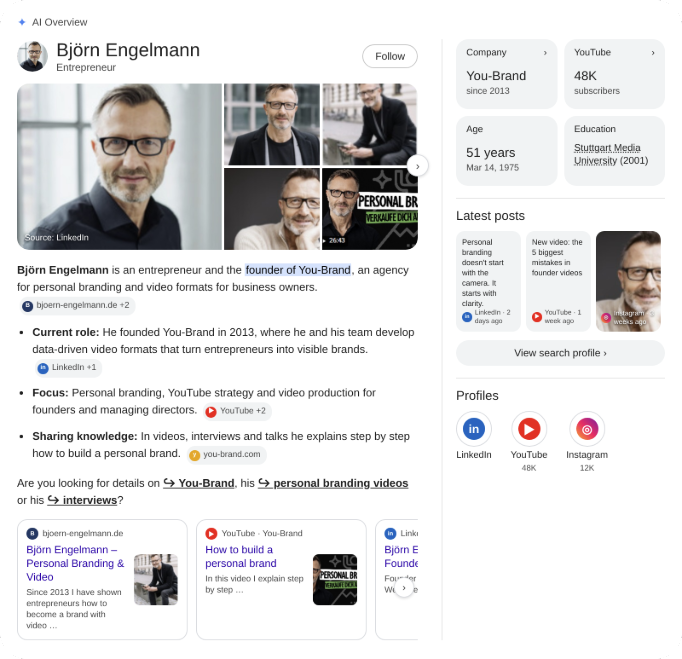
Our recreated illustration of Björn Engelmann shows what such a panel might look like for a person. It is an illustration, not a screenshot - reports so far cover brands and companies, not people. The building blocks, however, are familiar from today's panels and AI Overviews:
- A header with name, a short descriptor (for example “Entrepreneur”) and a follow button
- A photo strip of images Google associates with the person
- An AI paragraph explaining in two or three sentences who the person is - with source references right next to the statements
- Structured bullet points such as current role, focus and areas of expertise, each with a linked source
- Follow-up questions that let users dig deeper straight away
- Fixed facts in the sidebar: company, age, education, channels with reach, latest posts and official profiles
What is documented - and what remains speculation
- Documented: AI Overviews inside the panel for many brand searches on desktop in the US, observed from October 31, 2026.
- Documented: The Knowledge Graph fact lines remain below the AI text.
- Open: whether Google rolls the view out permanently, extends it to people or brings it to other countries and languages.
- Open: what the panel will look like on mobile, where space is tighter.
- Speculation: The person view shown is a scenario combining existing building blocks.
The five big shifts
Even though much is still open, the direction is clear. Five changes are emerging.
- From displaying to writing: The panel used to show stored facts. Going forward, an AI writes the first sentence about a person or company.
- From click to answer: People who read the summary click through less often. The first impression forms right in search.
- From one source to many: The AI draws on websites, profiles, press, directories and databases. Each of these sources can help write the text.
- From stable to changing text: Panel facts rarely change; an AI text can read differently with every search.
- From Google to every AI system: ChatGPT, Perplexity, Gemini and Copilot use the same entity data when they describe who someone is.
Why contradictions now become visible
An AI summarises what it finds. When sources agree, the text is clear. When they contradict each other, the contradiction ends up in the text. A documented example: for Zillow, the AI text gave 2006 as the founding year while the fact line right below said 2004. The company was founded in 2004 and its website launched in 2006 - the AI mixed the two up.
For people the risk is greater. Namesakes, old positions, outdated bios on conference pages or a profile with the wrong birth year can all end up in a summary that sits in the most prominent spot in search. And unlike the fact lines, the AI text cannot be edited directly.
Why working on your own entity matters more than ever
When an AI writes the first sentence about you, the data behind your name becomes your real business card. You cannot order an AI answer. You can influence what it is built from.
That takes a clear entity Google can reliably tell apart from others; details that match across website, profiles and directories; structured data that says exactly what is visible on the page; and independent sources such as press, expert articles or databases that confirm those details.
This work used to mainly shape the fact lines. Now it shapes facts and AI text at once - and, beyond Google, every system that builds answers from entity data. Those who get organised now create a foundation for several platforms. Those who wait leave the gaps to the AI. Nobody can guarantee a particular wording, but a consistent, well-evidenced foundation increases the chance that the summary is accurate.
What you can prepare now
- Search your own name regularly in a private window, on desktop and mobile, and keep screenshots.
- Choose one reference page, such as your About page, with a factual first paragraph: who, what, since when, where.
- Add structured data that matches the visible text exactly, including links to your official profiles.
- Align all profiles and listings: same name, same role, same core details.
- Track down outdated bios on third-party sites and ask for updates.
- Verify an existing Knowledge Panel so you can correct facts with evidence.
- Report errors in the AI text via feedback as well - but only a fix at the source helps for good.
Sources
Frequently asked questions
What is the “new” Knowledge Panel?
A Knowledge Panel with an AI Overview at the top and the familiar facts below. In the US it appears for many brand searches on desktop. Google has not officially confirmed it.
Does the new panel exist for people too?
There is no documentation of that so far. The person view shown is a recreated illustration of what it might look like.
Can I edit the AI text in my panel?
No. Only the facts of a verified panel can be edited through Google's suggestion feature. You influence the AI text through the sources it is built from.
Why does this make entity work more important?
Because the same data now not only fills fact lines but shapes the first sentence people read about you - on Google and in other AI systems. A clear, consistent and confirmed data foundation increases the chance of an accurate summary, but does not guarantee it.
What should I do first?
Document your own search, set up a reference page with clear facts and align all profiles. Structured data and independent sources come next.
Free Brendit feasibility check: an honest, no-obligation check of how Google and six AI systems present you today.
Get your free feasibility check