In this article
What has been observed
On 31 October 2026, SEO consultant David McSweeney noticed that for brand terms, Google no longer shows the AI Overview above the search results but to the right of them. Search Engine Roundtable picked this up on 2 November, and a day later PPC Land documented several examples: Apple, Zillow, Coca-Cola and Google itself.
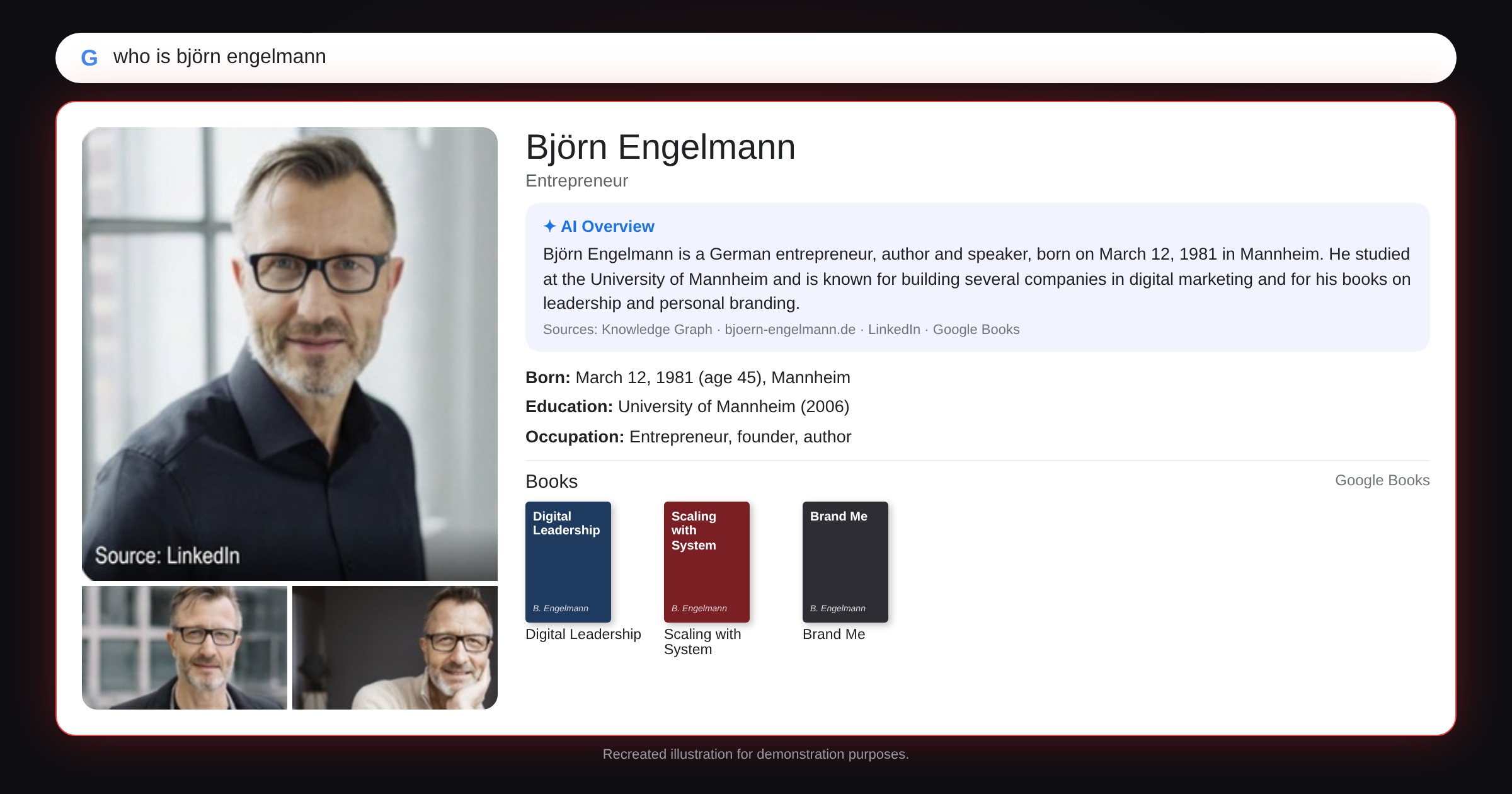
The Knowledge Panel remains, but gets a new opening section. At the top is a text about the company written by the AI. Below it come the familiar fact lines such as founder or founding year, and for retailers additional details such as ratings and shipping.
The move didn't come out of nowhere. In October 2026, Ahrefs analysed around 232.8 million US desktop search results. In July, 61.3 percent of brand searches showed an AI Overview; in September it was 73.3 percent, and on 29 September almost 83 percent.
What is documented - and what isn't
What is documented are observations from the US, on desktop, for the names of companies and brands. Nothing more.
- Google has neither announced nor confirmed the change. Whether it is a test or here to stay is still open.
- It affects some brand terms, not all of them.
- The reports cover companies and brands. They say nothing about searches for people.
- For Germany, Austria and Switzerland, there is no comparable documentation so far.
Why this is more than a new layout
So there is no reason to panic. But there is a good reason to take the direction seriously: Inside the panel, AI is increasingly putting into words what used to come solely from a fixed database.
Anyone searching for a name usually wants to check who they are dealing with - before a purchase, a meeting or a collaboration. What appears in this spot shapes the first impression more strongly than any subpage.
The facts in the Knowledge Panel come from the Knowledge Graph. The panel can be verified, and the owner can suggest corrections backed by evidence. The AI text above those facts, by contrast, is summarised afresh from many pages with every search. It cannot be edited. Google itself points out that AI Overviews can contain mistakes.
The Zillow example shows what this looks like: the AI text gave 2006 as the founding year, while the fact line directly below said 2004. Both have a source - the company was founded in 2004, and the website launched in 2006. The AI did not keep the two facts apart.
Fact lines and AI text compared
- Where the content comes from: the fact lines from the Knowledge Graph and vetted sources. The AI text from many web pages.
- Who can correct it: for the facts, the verified owner via Google's suggestion feature. For the AI text, nobody directly - all that remains is feedback via the thumbs-down button.
- How stable it is: the facts rarely change. The AI text may be phrased differently from one search to the next.
- How errors can be fixed: in both cases, permanently only at the source Google took the information from.
The AI reads the same sources as the Knowledge Graph
In practice, this is the most important insight. The AI doesn't invent its description freely; it summarises what it finds about a name: your own website, profiles, press, databases. According to Ahrefs, Wikipedia was cited very frequently in the AI Overviews examined for well-known brands. These are the same sources Google also uses to build entities for the Knowledge Graph.
So the display changes, not the task. If the same facts appear everywhere, you get a coherent summary. If you have three different founding years, two company names and an outdated address on the web, that exact contradiction is what gets played back as text.
That's why our work continues to follow the C4 Method™ by Brendit: Clarity, Consistency, Credibility and Catalyst. If anything, AI summaries make Consistency more important, because any contradiction can become visible. How this relates to being recommended by AI assistants is covered in Getting Recommended by ChatGPT.
What you can do now
- Check your own search: search for your name in a private window on desktop and on your smartphone, and save screenshots. That way you can see later what has changed.
- Define one page as the reference: the About us or About me page with a factual first paragraph - who, what, since when, where. Facts instead of marketing speak.
- Add structured data that matches the visible text exactly: name, legal name, website, founding year, address and the links to the official profiles.
- Align profiles and listings: the same name, the same description, the same details on every platform and in every directory.
- Verify an existing Knowledge Panel. How that works is explained in Editing a Knowledge Panel.
- Fix errors at the source and also report them to Google. Feedback alone changes nothing as long as the incorrect information remains on the web.
- Check once a month, and additionally after major Google updates.
The most common mistakes
- Assuming the AI text can be edited like the facts in the panel
- An About us page full of slogans from which not a single fact can be extracted
- Structured data that says something different from the visible text
- Leaving old company names, addresses and roles in directories and profiles
- Maintaining only your own website and ignoring independent sources
- Panicking, even though the change has not been confirmed outside the US
Sources
Frequently asked questions
Is the AI Overview replacing the Knowledge Panel?
No. The panel remains. For many brand searches in the US on desktop, AI text now appears at the top of the panel, with the facts below it. Google has not confirmed this. It is an observed pattern, not an announced rule.
Does this also apply in Germany, Austria and Switzerland?
There is no reliable documentation of that so far. The known examples come from the US. Check your own search regularly yourself.
Are searches for people affected too?
The available reports cover companies and brands. They say nothing about people. The foundation is the same, though: Google describes what the sources consistently say.
Can I change what the AI writes about me or my company?
Not directly. You can report incorrect information via feedback and, above all, correct the sources the AI took it from.
Is working on a Knowledge Panel still worth it, then?
Yes, more than ever. The panel remains the place where Google describes a person or company. The facts and the AI text draw on the same sources. A clear, consistent and independently confirmed set of facts affects both.
Free Brendit feasibility check: an honest, no-obligation check of how Google and six AI systems present you today.
Get your free feasibility check